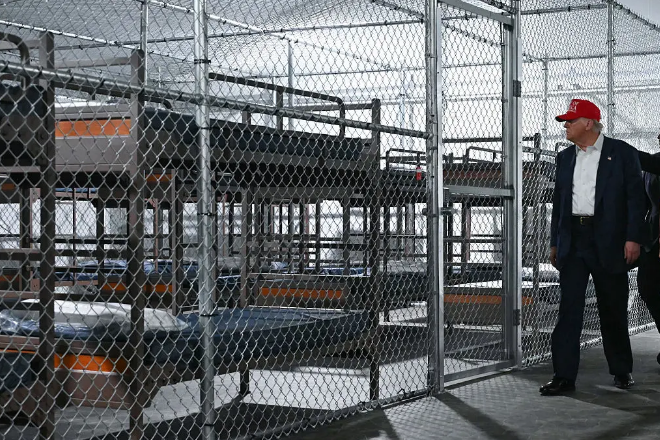
As the Trump Administration pushes to expand Immigration and Customs Enforcement (ICE) detention capacity across the United States, communities, elected officials, and property owners are fighting back.
The Administration’s “Big Beautiful Bill” allocated $45 billion to ICE for new detention centers as part of a broader $170 billion package for immigration enforcement. Over the past month, ICE acquired or attempted to acquire properties in at least eight states, including a $102 million site in Maryland, $84 million in Pennsylvania, and $70 million in Arizona.
The effort has faced growing scrutiny following the fatal shootings of two U.S. citizens by federal agents in Minneapolis in January. Local opposition has emerged in multiple cities where the agency targeted warehouses for conversion into detention facilities.
In Mississippi, Republican Senator Roger Wicker criticized plans for a large facility in Byhalia, noting that the town lacks the medical and human services to support more than 8,500 detainees.
In Oklahoma City, community opposition successfully blocked ICE’s attempt to acquire a warehouse near the Western Heights School District. Mayor David Holt, a Republican, said the property owners confirmed they would no longer engage with the Department of Homeland Security regarding a sale or lease.
Salt Lake City faced a similar pushback. Mayor Erin Mendenhall sent a letter to the owner of a warehouse on the city’s west side, warning that converting the building into a detention center would violate zoning codes and strain local infrastructure. Residents also staged a protest outside the warehouse in early January, waving flags and holding “ICE OUT” signs. The building’s owner later confirmed no sale or lease would occur.
In Kansas City, federal agents toured a potential facility in mid-January. The city council quickly approved a moratorium on approvals for nonmunicipal detention facilities until 2031, effectively blocking ICE’s plans. Property owners said negotiations had ended and that no further discussions were planned.
Similar opposition arose in Ashland, Virginia, where Canadian company Jim Pattison Developments canceled the sale of a 550,000-square-foot warehouse to DHS after public protests and pressure from local leaders. Hanover County officials reported that hundreds of residents attended rallies opposing the transaction.
In Maryland, Howard County revoked a permit for a proposed detention facility in Elkridge. County Executive Calvin Ball criticized the lack of transparency and oversight in retrofitting private office buildings for detention use. Local legislators have proposed bills aimed at preventing the conversion of such buildings into ICE facilities.
The Administration’s detention expansion efforts, intended to house thousands of detainees, are encountering resistance at every stage. From city councils to state leaders and local communities, opponents argue that the facilities would overburden infrastructure, pose safety risks, and raise ethical concerns about the federal immigration crackdown.