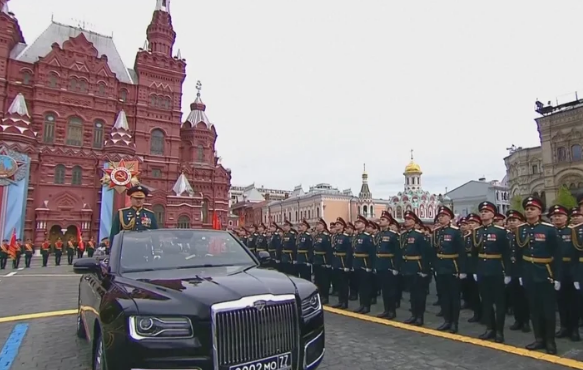
Russia has staged a notably scaled-back Victory Day parade in Moscow, reflecting heightened security concerns and the strain of the ongoing war in Ukraine, now entering its fifth year.
The annual 9 May event, held on Red Square, is one of Russia’s most significant national commemorations, marking the Soviet Union’s victory over Nazi Germany in 1945 and honouring the estimated 27 million Soviet citizens who died during the Second World War. Traditionally, the parade has served as a powerful display of military strength, often featuring tanks, missile systems, and other heavy equipment.
This year, however, no armoured vehicles rolled across Red Square. The absence of major military hardware underscored fears of potential Ukrainian attacks, as well as the broader impact of a conflict that has proven far more prolonged and costly than Moscow initially anticipated.
President Vladimir Putin attended the ceremony alongside veterans and senior officials, watching as troops—some of whom have served in Ukraine—marched through the square. Fighter aircraft flew overhead in formation, while Putin delivered an eight-minute address praising Russia’s armed forces and drawing parallels between the Second World War and the current conflict.
He described Russian troops in Ukraine as facing what he called an “aggressive force supported by the entire NATO bloc,” insisting that they would prevail despite continued resistance.
The parade took place under tight security measures, with armed personnel deployed across central Moscow and roads closed in anticipation of potential threats. The capital, home to more than 20 million people in its wider metropolitan area, has remained on heightened alert throughout the war.
The Victory Day celebrations come against a backdrop of intensified fighting and repeated accusations between Russia and Ukraine over ceasefire violations. A temporary three-day truce, announced by US President Donald Trump and supported by both sides, was intended to coincide with the commemorations, alongside a proposed prisoner exchange involving 1,000 detainees.
The conflict, which began with Russia’s invasion of Ukraine in 2022, has caused widespread destruction and significant loss of life. It has also severely strained Russia’s economy and deepened its diplomatic isolation from much of Europe.
While Kremlin officials dismissed speculation about internal instability or security threats, the reduced scale of the parade and absence of heavy weaponry highlighted the changing tone of an event once designed to project unchallenged military power.