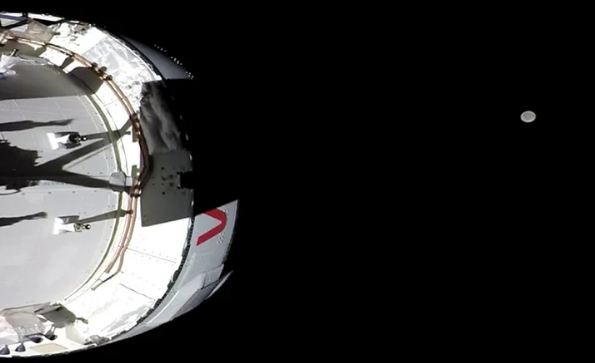
The Artemis II crew has captured sights of the Moon never before witnessed by humans, NASA reported, as their spacecraft passed the two-thirds mark of its ten-day mission.
As the astronauts closed out the fourth day of their journey, they were nearly 322,000 km from Earth and 132,000 km from the Moon, according to NASA’s live dashboard. The space agency shared an image from the crew showing the Orientale basin, a massive bullseye-shaped crater. “This mission marks the first time the entire basin has been seen with human eyes,” NASA said.
Astronaut Christina Koch told Canadian schoolchildren during a live session that the crew was most excited to observe the crater, sometimes called the Moon’s “Grand Canyon.” “It’s very distinctive, and no human eyes had previously seen this crater until today,” she said.
The mission is approaching another milestone as the crew prepares to enter the Moon’s “lunar sphere of influence,” where the satellite’s gravity will exceed Earth’s pull on the Orion spacecraft. If all goes according to plan, astronauts Christina Koch, Reid Wiseman, Victor Glover, and Canadian Jeremy Hansen could set a record for the farthest humans from Earth.
NASA said the crew has already completed a manual piloting demonstration and reviewed their lunar flyby plan, identifying surface features to photograph and study. Earlier in the day, the astronauts began with scrambled eggs and coffee, accompanied by the pop song “Pink Pony Club.” Commander Reid Wiseman, speaking to Houston Mission Control, described the mood aboard Orion as high.
Mr Wiseman shared a personal highlight, speaking with his daughters from space. “We’re up here, we’re so far away, and for a moment, I was reunited with my little family,” he said. “It was just the greatest moment of my entire life.”
The crew has trained in geology to document lunar features, including lava flows and impact craters, offering a unique perspective compared with the Apollo missions. Whereas Apollo flights orbited about 70 miles above the Moon, Artemis II will pass roughly 4,000 miles from the surface, allowing the astronauts to see the complete lunar globe, including both poles.
“The first view of the Moon’s far side last night was absolutely spectacular,” Ms Koch said, describing how the crew had seen regions previously captured only by robotic spacecraft. NASA also released a new image highlighting lunar features visible for the first time to human eyes. The astronauts have been using smartphones onboard to capture photographs, supplementing Orion’s imaging equipment.
Artemis II is part of NASA’s long-term plan to return repeatedly to the Moon, aiming to establish a permanent lunar base and expand human exploration deeper into the solar system. For the crew, the journey still allows moments of wonder and excitement. “It just makes me feel like a little kid,” said Mr Hansen, reflecting on the joy of floating in orbit.