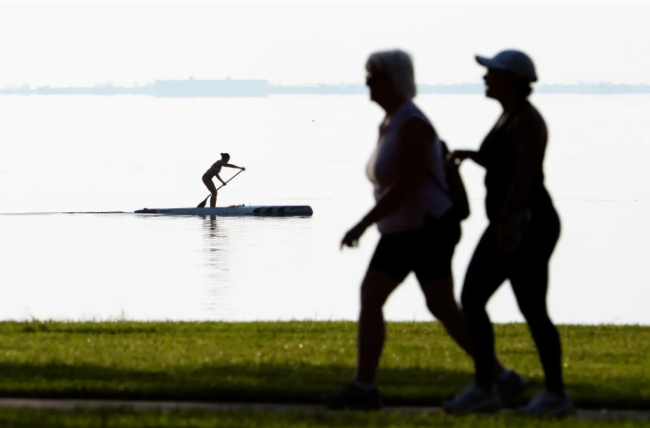
A new study has found that even a small amount of physical activity—such as walking just once a week—can significantly improve heart health and longevity in older women.
Published Tuesday in the British Journal of Sports Medicine, the research tracked more than 13,000 women with an average age of 72. It found that walking around 4,000 steps, equivalent to roughly one to two miles, just once a week was associated with a noticeable reduction in the risk of developing cardiovascular disease or dying during the study period.
Women who achieved this modest level of activity once or twice weekly were 27% less likely to develop heart disease and 26% less likely to die from any cause compared to those who remained mostly sedentary.
“These findings show that even a small effort can make a meaningful difference,” said Dr. Rikuta Hamaya, the study’s lead author and an instructor in medicine at Brigham and Women’s Hospital in Boston.
The study challenges the long-standing notion that people must walk 10,000 steps a day to stay healthy—a goal popularized by early pedometer marketing rather than scientific evidence. “That number was never based on research,” explained Amanda Paluch, a kinesiology professor at the University of Massachusetts Amherst, who studies physical activity patterns.
Researchers monitored the participants’ step counts over a week and then followed them for more than a decade to observe health outcomes. The findings indicate that even irregular bursts of movement, rather than daily activity, can have measurable benefits.
Dr. Shaan Khurshid, a cardiac electrophysiologist at Massachusetts General Hospital who was not involved in the study, said the results offer a hopeful message for people struggling to maintain a consistent exercise routine. “Even if you’re not active every day, you can still see real benefits from the days you do move,” he noted.
Experts say the research supports a shift away from an “all-or-nothing” mindset toward physical activity. Previous studies have also shown that “weekend warriors”—those who exercise primarily on one or two days a week—enjoy better health outcomes than those who remain inactive.
However, researchers cautioned that the findings may not apply to everyone, as the study primarily involved older, white women. More research is needed to understand the effects of occasional exercise among younger and more diverse populations.
Still, the message is clear: even small, infrequent steps toward physical activity can lead to big improvements in long-term health. As Paluch put it, “If you’re thinking about being more active, even starting with one day a week can be incredibly meaningful.”