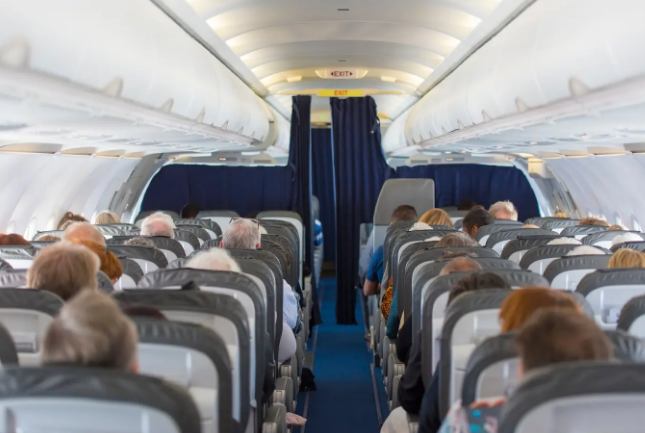
As holiday travel ramps up, questions about the cleanliness of airplane air are on many passengers’ minds. A new study from Northwestern University suggests that the microbes circulating in aircraft cabins are largely harmless and similar to those found in other indoor environments, such as hospitals.
Erica Hartmann, associate professor of civil and environmental engineering, and her team analyzed face masks worn by passengers on flights as well as by hospital staff to track the microbial species present in the air. The study, published in the journal Microbiome, focused on the microbes collected on the outer layers of 53 masks, ensuring that only airborne organisms were examined rather than those from the wearer’s respiratory tract. DNA from the microbes was extracted and amplified using polymerase chain reaction (PCR) to identify a wide range of species.
The team detected 407 microbial species across both settings. Most of these originated from human skin, which Hartmann described as a “microbial aura” that people shed as they move through indoor spaces. “A lot of the surfaces we touch tend to have skin-associated bugs because we are transferring microbes every time we touch something,” she said.
While the study captured primarily bacterial DNA, it did not focus on viruses, which require RNA-based detection. Hartmann noted that viruses, such as influenza or COVID-19, make up a smaller portion of microbes in the air compared with bacteria, since humans shed skin bacteria in larger quantities. However, she cautioned that even a small number of virus particles can cause infection and that some viruses can survive outside the human body.
The findings highlight the need for improved air monitoring systems that can detect harmful pathogens in real time. Hartmann envisions devices similar to carbon monoxide detectors, which could automatically adjust air circulation or provide alerts when microbial levels rise. Such innovations could help passengers and staff make informed decisions about protective measures, including mask use.
Until then, the study reassures travelers that indoor air, even in confined spaces like airplanes or hospitals, may not be as hazardous as feared. Hartmann emphasized that wearing face masks remains an effective way to reduce exposure to airborne pathogens and prevent the spread of germs to others.
The research provides a clearer picture of the microbial environment in high-traffic indoor spaces, suggesting that most organisms in the air are benign, while also reinforcing the continuing value of basic precautions like mask-wearing during cold weather and peak travel periods.