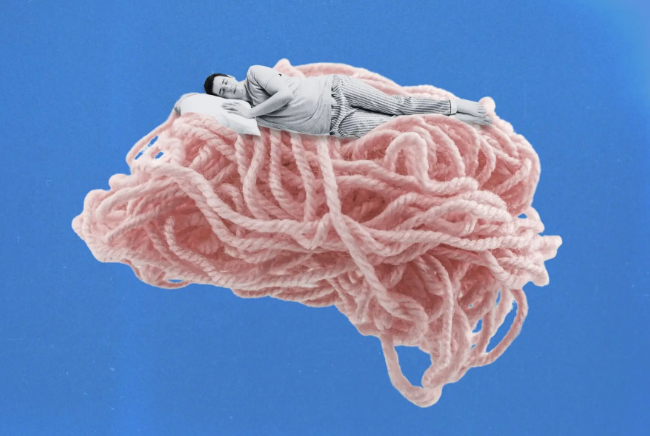
The long-standing advice to “sleep on it” when faced with a difficult problem has gained further scientific backing, with new research revealing how the brain continues to work through challenges even after we drift off.
A recent study published in the Journal of Neuroscience monitored 25 participants as they performed a memorization task, using electroencephalography (EEG) and magnetoencephalography (MEG) to track brain activity. Following the task, the participants took an afternoon nap while still connected to the sensors.
Researchers focused on detecting “sleep spindles”—brief bursts of brain activity that occur during lighter stages of sleep. These spindles were found to be most active in the same brain regions engaged during the memorization exercise. Higher spindle activity correlated with better performance when participants repeated the task after their nap.
“Brain rhythms occur everywhere in the brain during sleep,” explained Dara Manoach, professor of psychiatry at Harvard Medical School and co-author of the study. “But the rhythms in these regions increase after learning, presumably to stabilize and enhance memory.”
The findings align with earlier research by Alyssa Sinclair, a postdoctoral fellow at the University of Pennsylvania, who found that participants made more rational decisions after sleeping on difficult tasks. “When we let them sleep on it, they made somewhat more rational choices,” Sinclair said, noting that the brain appears to become less influenced by first impressions after rest.
This process is driven largely by the hippocampus, a brain region central to processing short-term memories. During sleep, the hippocampus “replays” important experiences, deciding which to transfer into long-term storage in the neocortex and which to discard. Together, these regions also reorganize and analyze stored information, making new connections that may have been overlooked while awake.
Daniela Grimaldi, research associate professor at Northwestern University’s Feinberg School of Medicine, said deep or slow-wave sleep provides optimal conditions for memory transfer, helping to preserve valuable experiences while filtering out less important details.
Other sleep phases also play a role. Research published in Science Advances in 2023 showed that even N1—the lightest stage of sleep—can boost creative problem-solving. Participants exposed to a complex math problem tripled their chances of solving it after spending just 15 seconds in this phase.
Experts say people can increase their chances of benefitting from these processes by keeping a dream journal or voice recorder by the bed to capture ideas upon waking. “Upon waking, remain still with eyes closed for a moment, allowing dreams and insights to crystallize,” advised Matthew Walker, professor of neuroscience at the University of California, Berkeley.
As Sinclair summed up: “Creative problem solving improves after a period of sleep, helping us piece together what we’ve been thinking about, filter out irrelevant information, and reach better conclusions the next day.”