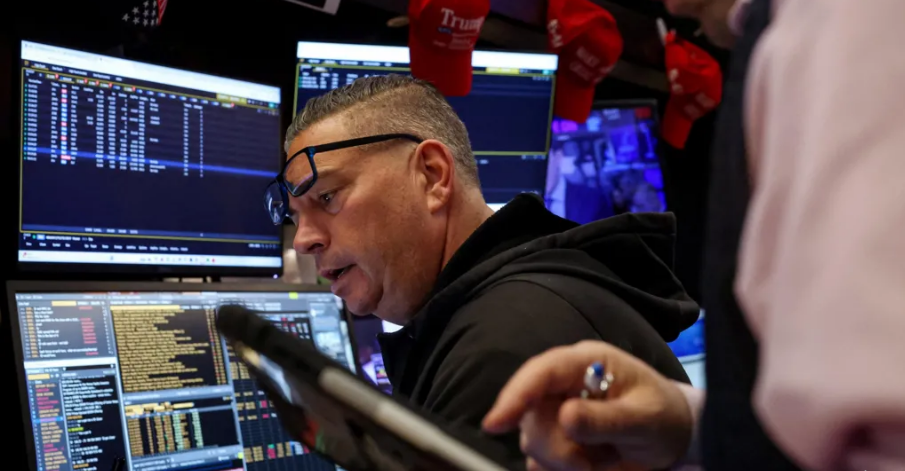
Despite strong corporate results and positive economic data, US and Asian stock markets fell sharply on Thursday, highlighting persistent investor concerns about an AI-driven market bubble and uncertainty over interest rates.
In the United States, the three major stock indexes reversed an early morning rally. The S&P 500 ended 1.5% lower, the Dow Jones Industrial Average fell 0.8%, and the Nasdaq dropped more than 2%. Shares in AI chip maker Nvidia, which had surged in early trading following its quarterly results, fell over 3% by the close. Walmart also reported strong sales, and September hiring data showed better-than-expected gains, but the news failed to calm markets.
Analysts pointed to the concentration of gains among a handful of large technology companies. The so-called “magnificent seven” – Alphabet, Apple, Microsoft, Nvidia, Amazon, Meta, and Tesla – now make up roughly one-third of the S&P 500. “When momentum is going down, people get nervous, and that is what we are seeing now,” said Colleen McHugh, investment consultant at Wealthify.
Bitcoin also extended its recent decline, slipping below $90,000 for the first time since April. Analysts linked the drop partly to investor unease over AI valuations. Nvidia’s chief executive, Jensen Huang, dismissed fears that AI companies are overvalued, stating that the market’s potential remains strong. Still, Wall Street remains cautious, with traders highlighting the risks of concentrated gains and rapid price swings in technology stocks.
Markets in Asia followed the downward trend. Japan’s Nikkei 225 closed 2.4% lower, dragged down by SoftBank, which fell nearly 11%. South Korea’s Kospi lost 3.8%, with SK Hynix down almost 9% and Samsung nearly 5.8% lower. Hong Kong’s Hang Seng fell about 2%.
Economic uncertainty continues to weigh on investors. Key inflation data delayed during the US government shutdown has heightened speculation over the Federal Reserve’s next move on interest rates. While the September jobs report showed employers added 119,000 positions – more than double expectations – the unemployment rate rose from 4.3% to 4.4%. Analysts said the mixed figures leave the path for Fed rate cuts unclear.
Eric Teal, chief investment officer at Comerica Bank, highlighted ongoing questions about economic conditions and policy: “Growing jitters about an AI bubble and inflation could inject even more volatility into financial markets. When a market is priced at perfection, any doubts about growth or policy can trigger sharp reactions.”
Oxford Economics analysts described the current technology sell-off as a healthy correction rather than a broader market crisis but warned that profit-taking and concentrated risk among AI-focused firms could continue to drive short-term volatility. Investors are now weighing strong earnings and robust tech adoption against broader concerns over inflation, interest rates, and sustainability of the AI-driven rally.