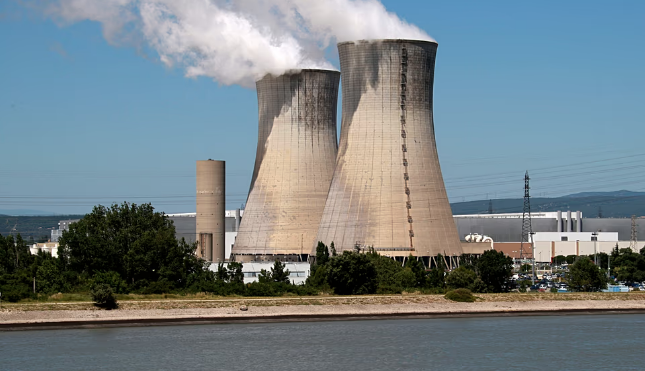
France’s state-owned energy firm EDF has temporarily closed three nuclear power plants and stated it could operate seven others at lower capacity as a severe heat wave affects the nation, forcing it to adhere to environmental rules aimed at safeguarding rivers and aquatic ecosystems.
The reactors have been shut down due to the fact that the plants are cooled with river water, which is then returned to the waterways. EDF said the extreme weather would make it difficult to maintain normal operations as river temperatures continue to climb above the allowed environmental levels.
There is no nuclear safety risk, reactors can function at high temperatures, these restrictions are designed to safeguard aquatic flora and fauna,” said an EDF spokesperson.
Out of service reactors are Unit 2 at the Golfech nuclear plant, 1,300MW, Unit 3 at Bugey, 900MW and Unit 2 at Chooz, 1,450MW. The three reactors have a total capacity of approximately 3.65 gigawatts, or about six percent of France’s 61 gigawatts of installed nuclear generation capacity.
Current weather forecasts suggest the reactors will remain closed until the weather improves, EDF said. The restart of Bugey Unit 3 is planned for July 19, Golfech Unit 2 for July 22 and Chooz Unit 2 for July 25. The company pointed out that if the weather forecasts change, these dates may be adjusted.
Outside of the shutdowns, seven other reactors will need to modify their electric generation during the day to stay within environmental limits, EDF said.
France’s Economy Ministry has already issued a temporary exception for the Bugey plant on the Rhône river to allow the plant to continue operating until 20 July because it was necessary to keep supplying electricity and to prevent the national power grid from collapsing.
The shutdowns are the second such reductions of nuclear power due to extreme heat in recent weeks. In June, France endured another record-breaking heatwave, further complicating electricity production as a result of climate conditions.
The long-term effect of heatwaves and droughts on nuclear generation has been relatively modest, despite the disruption, said EDF. Since 2000, the losses from high water temperatures and low water flows have been 0.3 percent of the French nuclear fleet’s electricity output on average each year.
The company is also investing in long-term adaptation actions for climate change. In an earlier statement earlier this year, EDF revealed an €8.7 billion programme to make its nuclear, hydropower and island energy businesses more resilient in the coming 15 years.
The technology being proposed to cool released water prior to discharge into rivers, which is already in place at the Civaux Nuclear Power Plant, is one of the measures being considered. EDF is also developing flood management solutions and ensuring continuity of hydropower generation in periods of low river levels, as well as strengthening electricity networks in French territories in the islands to withstand the growing impact of extreme weather.